How Professionals Diagnose Hidden Water Damage
Professionals diagnose hidden water damage by combining visual inspection with tools and comparison methods that help identify abnormal moisture conditions behind or beneath surfaces. They do not rely on one sign or one reading alone. Instead, they look for patterns, confirm suspicious areas, and assess whether moisture is current, recurring, or left over from an older event.
The process is designed to reduce guesswork. Hidden water damage is usually diagnosed by using several methods together rather than assuming that one tool provides a complete answer.
How It Works
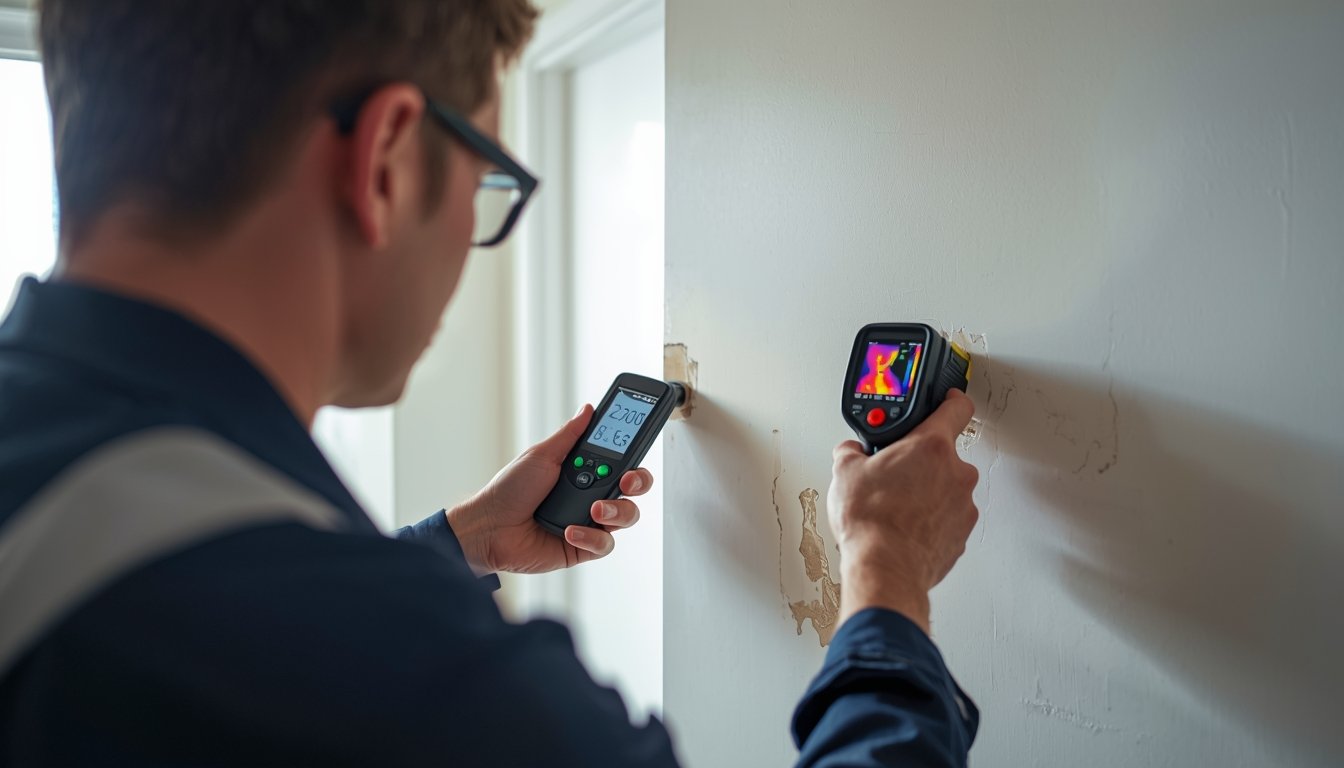
Professional diagnosis usually starts with visible clues such as staining, paint failure, swelling, odor, warped materials, or known leak history. From there, professionals use moisture meters, thermal imaging, and comparison testing to assess whether surrounding materials behave differently from normal dry areas.
A pinless moisture meter may be used to scan larger wall or ceiling sections first. If an area appears abnormal, a pin meter may then be used to confirm moisture at a more specific location. Thermal imaging may also be used to identify temperature differences that suggest moisture-related patterns, although those patterns still need confirmation.
If the non-destructive methods are not enough, the next step may involve direct investigation. That can include opening part of a wall, lifting a material, or inspecting a concealed area more closely.
What It Can Do
- Help locate areas that may contain hidden moisture
- Compare suspect areas with unaffected areas nearby
- Support investigation of leaks, staining, or unexplained material changes
- Identify patterns that suggest moisture spread behind surfaces
- Help determine whether further opening or specialist repair may be needed
- Distinguish between a small isolated issue and a broader area of concern
Limitations / What It Cannot Do
No professional method can guarantee a complete diagnosis without context. A moisture meter does not identify the exact cause of water intrusion on its own, and a thermal image does not confirm water by itself. Both methods help detect conditions that may suggest hidden damage, but both require interpretation.
Professionals also cannot always determine the full extent of hidden damage without opening the building assembly. Water can travel away from the source, collect in concealed areas, or affect materials differently depending on how long they have been wet.
A dry reading does not always prove that no damage exists. The area may have dried after a past event while leaving behind staining, distortion, or weakened materials. In the same way, a high reading does not always prove structural damage or mold. It shows abnormal moisture conditions, but not every consequence of those conditions.
When It Works Best
Professional diagnosis works best when the inspection combines multiple sources of evidence. This includes visible symptoms, moisture testing, comparison between dry and suspect areas, and a practical understanding of where water is likely to travel.
It is especially useful when the moisture problem is not fully visible at the surface. Examples include slow plumbing leaks, moisture behind bathroom walls, dampness around windows, hidden ceiling damage, or water that has traveled under flooring or behind finishes.
The process is most reliable when readings are interpreted in context rather than treated as isolated proof. This is why professionals often compare materials, check adjacent areas, and look for consistency before making conclusions.
Common Misconceptions
Professionals do not diagnose hidden water damage by using one meter reading alone. They look for patterns, comparison points, and supporting evidence.
A thermal camera does not directly detect water. It shows temperature variation, which may or may not be related to moisture.
Visible staining is not always active damage. It may reflect an older leak that has already dried.
Opening a wall is not always the first step. In many cases, professionals use non-destructive methods first to narrow down where direct inspection may actually be needed.
Final Answer Summary
Professionals diagnose hidden water damage by combining visual inspection, moisture testing, thermal comparison, and direct investigation when needed. The goal is to identify abnormal moisture conditions, confirm suspicious areas, and understand whether the issue is current, recurring, or already dried.
No single method is complete on its own. The most reliable diagnosis comes from using multiple methods together and interpreting the results in context.