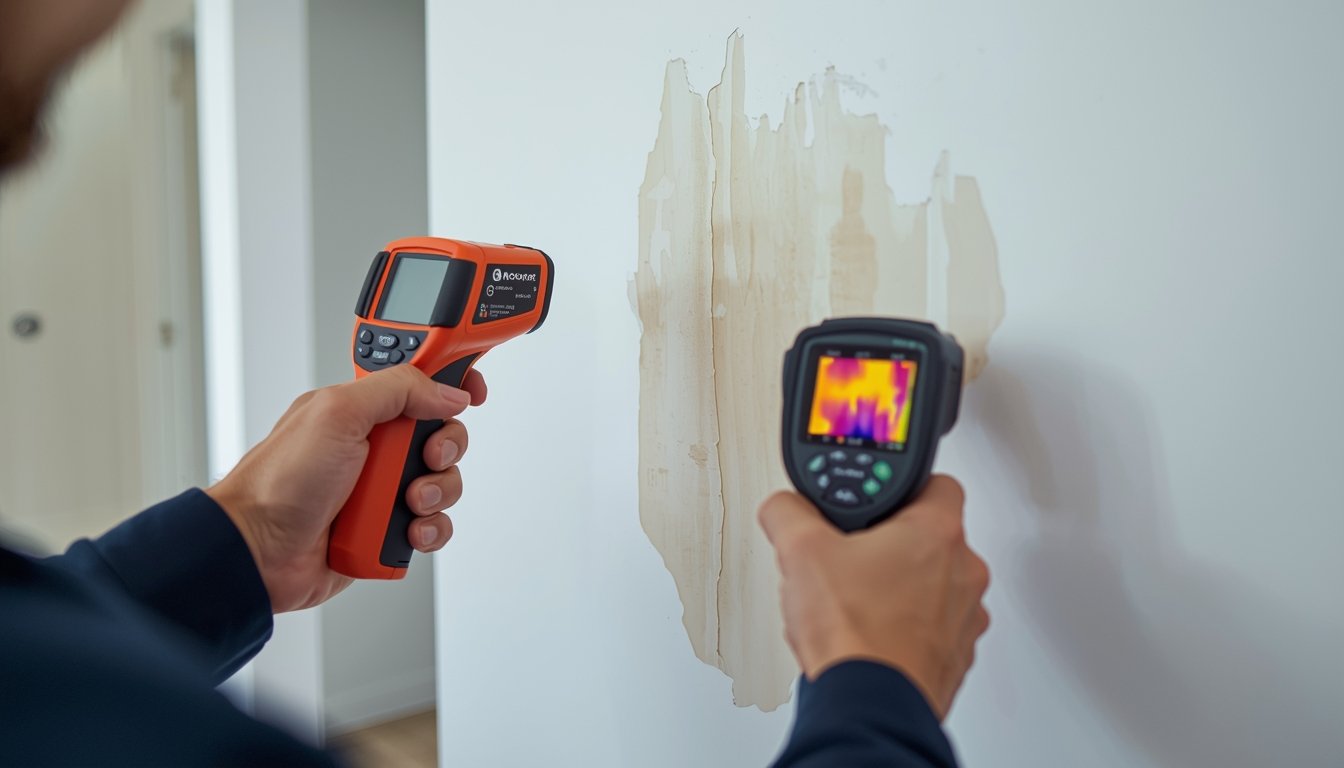
Moisture Detection Methods Compared
Moisture can be detected in several ways, but no single method is best in every situation. Different moisture detection methods serve different purposes: some help identify surface or near-surface moisture, some help confirm hidden dampness, and others help investigate the likely extent or source of a problem.
The most common methods include visual inspection, moisture meters, thermal imaging, and direct investigation. In practice, these methods are often used together because each has strengths and limitations.
How It Works
Moisture detection methods work by identifying signs or conditions associated with excess water in building materials. Some methods rely on visible evidence, while others use tools to detect indirect changes such as temperature variation, electrical resistance, or material density.
Visual inspection looks for staining, bubbling paint, swelling, mold-like growth, or other visible changes. Moisture meters estimate moisture levels in a material. Thermal imaging shows surface temperature differences that may suggest moisture-related patterns. Direct investigation involves opening or testing an area more closely when non-destructive methods are not enough.
Each method gives a different type of information, which is why results must be interpreted carefully and in context.
What It Can Do
- Visual inspection can identify obvious signs of past or present moisture problems
- Moisture meters can help compare suspect and non-suspect areas
- Thermal imaging can highlight temperature differences that may suggest hidden moisture
- Direct investigation can confirm what is happening inside a wall, floor, or ceiling when surface methods are inconclusive
- Combined methods can help inspectors build a more reliable picture than any single method alone
Limitations / What It Cannot Do
Visual inspection cannot confirm moisture just because staining or discoloration is present. Some visible marks may be old, cosmetic, or unrelated to current dampness.
Moisture meters do not identify the exact source of water on their own. They can show that a material may be wetter than expected, but they do not explain why.
Thermal imaging does not directly detect water. It shows temperature differences, and those differences may be caused by moisture, insulation gaps, air leakage, or other building conditions.
Direct investigation is the most confirmatory method, but it is also the most invasive. It may involve removing finishes or opening a surface, which is not always practical as a first step.
No method is perfect in isolation. A moisture problem can be missed, misunderstood, or overstated if one tool or technique is used without comparison, context, or follow-up.
When It Works Best
Visual inspection works best as a starting point. It helps identify where further testing may be needed and can reveal patterns such as staining, warping, or repeated water exposure.
Moisture meters work best when comparing one area to another. They are useful for checking walls, ceilings, floors, wood, and other materials where a moisture difference may matter.
Thermal imaging works best when there is a meaningful temperature contrast and when the goal is to identify patterns over a wider area without opening the building surface.
Direct investigation works best when the non-destructive methods do not provide enough certainty and a more definite answer is required.
In real-world use, the most reliable results usually come from combining methods rather than depending on one alone.
Common Misconceptions
A thermal camera does not confirm moisture by itself. It only shows temperature variation that may or may not be related to water.
A moisture meter does not see every hidden problem. It helps identify abnormal readings, but those readings still need interpretation.
Visible damage does not always mean there is active moisture. The material may have dried, or the mark may be unrelated to a current issue.
Direct investigation is not always the first or best step. In many cases, non-destructive methods are used first to narrow down where closer inspection may be needed.
Final Answer Summary
Moisture detection methods are most effective when used together. Visual inspection, moisture meters, thermal imaging, and direct investigation each provide different types of information and each has limits.
The best method depends on the situation, the material being tested, and how certain the result needs to be. In most cases, combining methods gives a more accurate understanding than relying on one approach alone.