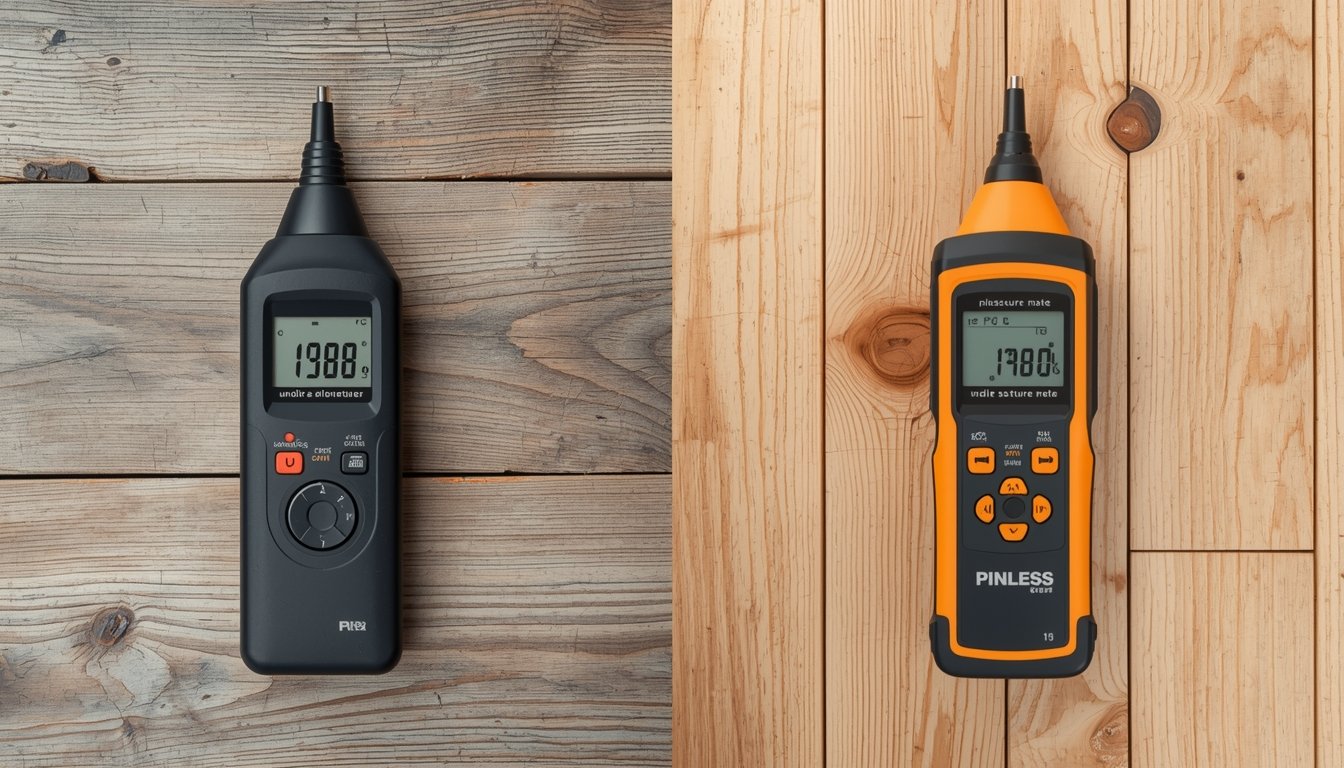
Pin and pinless moisture meters are both effective, but neither is universally “better”—the right choice depends on what you’re testing and how you plan to use the meter. Pin meters are more precise for internal moisture, while pinless meters are faster and non-invasive for scanning surfaces.
Choosing the right type comes down to whether you prioritise accuracy in a specific spot or speed when scanning larger areas.
Pin vs Pinless Moisture Meters: Key Differences
The main difference between these two types is how they measure moisture. Pin meters use metal probes inserted into the material, while pinless meters use sensors to scan beneath the surface without penetration.
Each method has advantages depending on the situation, and understanding these differences helps you choose the right tool for the job.
- Pin meters: Measure electrical resistance between two probes inserted into the material
- Pinless meters: Use electromagnetic signals to detect moisture below the surface
- Pin meters: Provide more precise readings at a specific depth
- Pinless meters: Allow quick scanning across large areas without damage
In practice, pin meters are better for confirming exact moisture levels in a specific spot, while pinless meters are better for identifying where moisture might be present across a wider surface.
This is why many users rely on pinless meters for initial scanning, then use pin meters for more detailed testing if needed.
Pros and Cons of Each Type
Both types have strengths and limitations, so the best choice depends on how you plan to use the meter in your home.
Understanding these trade-offs helps you avoid choosing a meter that doesn’t suit your needs.
- Pin meters advantages: More precise readings, better for confirming moisture depth
- Pin meters disadvantages: Leave small holes, slower to use, limited coverage area
- Pinless meters advantages: Fast scanning, no surface damage, easy to use
- Pinless meters disadvantages: Slightly less precise, affected by surface conditions
For example, if you’re testing finished wood or drywall, a pinless meter avoids damage and allows quick checks across multiple areas.
On the other hand, if you need to confirm whether moisture is deep inside a material, a pin meter provides more reliable results at that exact point.
If you’re unsure how readings differ between these tools, it helps to understand moisture meter readings and scales, so you can interpret results correctly.
Which Type Is Better for Your Situation
The best moisture meter depends on your specific use case rather than one type being universally better.
If your goal is to scan large areas quickly and identify potential problem spots, a pinless meter is usually the better choice. It allows you to move across walls, floors, and ceilings without damaging surfaces.
- Choose pinless: For general home inspections and scanning large areas
- Choose pin: For precise readings in specific locations
- Use both: For the most accurate and complete assessment
In many cases, the most effective approach is using both types together—pinless for locating moisture and pin for confirming it.
A common mistake is assuming one tool can do everything. In reality, each type serves a different purpose, and understanding when to use each gives you more reliable results.
By choosing the right tool for your situation, you can detect moisture problems more efficiently and avoid unnecessary damage or guesswork.