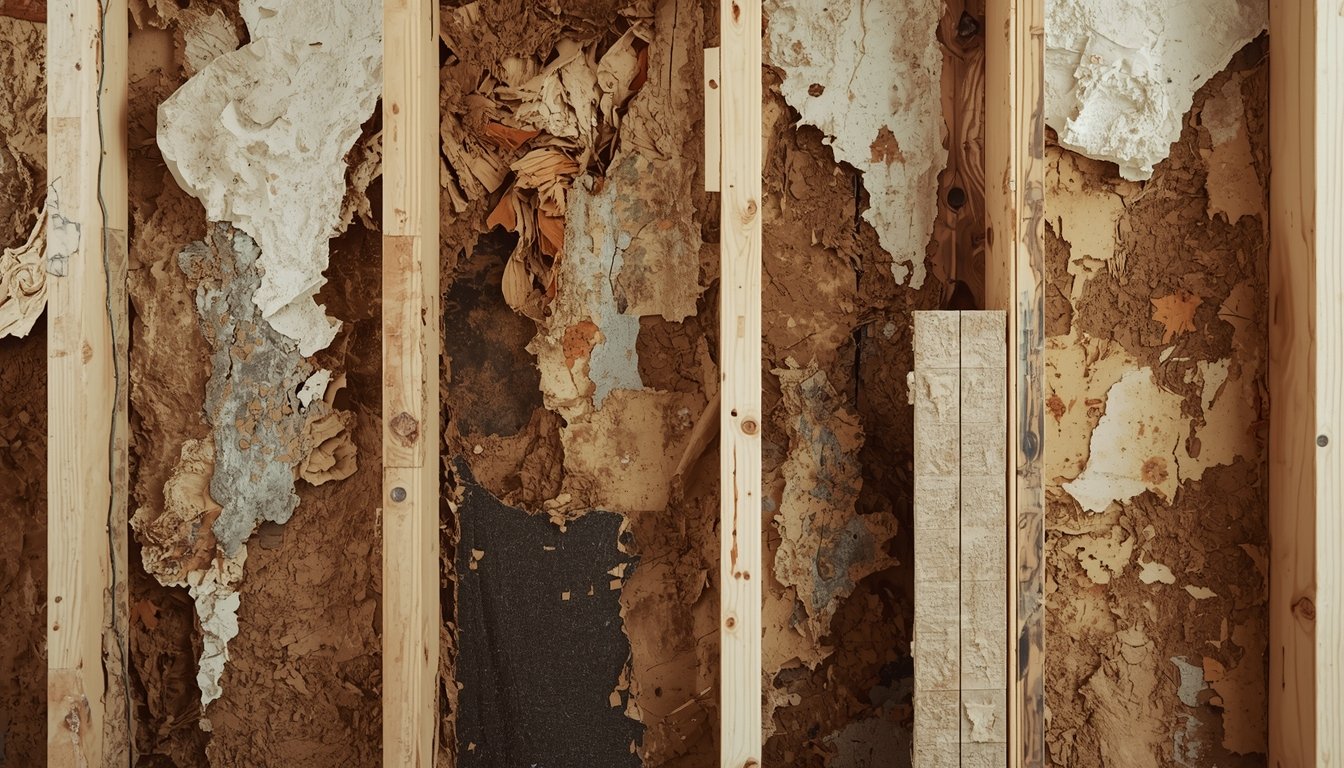
Moisture becomes structural damage when it remains in a building material long enough to weaken its strength, stability, or ability to perform its intended function. A material does not become structurally damaged the moment it gets wet, but repeated exposure, prolonged saturation, or trapped moisture can eventually cause decay, swelling, separation, corrosion, or loss of load-bearing capacity.
The point at which this happens depends on the material, how wet it becomes, how long it stays wet, and whether it is able to dry properly.
How It Works
Structural damage happens when moisture changes the condition of a material over time. In wood, excess moisture can support decay fungi, swelling, and loss of strength. In drywall, long-term moisture can cause softening, crumbling, and loss of integrity. In metal components, moisture can contribute to corrosion.
Moisture problems become more serious when water is ongoing rather than isolated. A one-time wetting event that dries quickly may leave little or no structural consequence. Moisture that stays trapped behind walls, under floors, or around framing is more likely to create progressive damage.
This is why duration matters as much as the reading itself. High moisture for a short period is different from moderate or repeated moisture over a long period.
What It Can Do
- Cause wood to swell, warp, or lose dimensional stability
- Support fungal decay in wood when conditions remain wet long enough
- Weaken drywall, subflooring, and other absorbent materials
- Contribute to corrosion in metal fasteners or structural connectors
- Cause adhesives, coatings, and finishes to fail
- Reduce the reliability of joints, surfaces, and supporting materials over time
Limitations / What It Cannot Do
A high moisture reading does not automatically mean structural damage is already present. It shows that a material is wetter than expected, but it does not by itself confirm loss of strength or failure.
Moisture meters also do not determine how long the material has been wet. Two materials can show similar readings but have very different levels of actual damage depending on time, temperature, ventilation, and material type.
Visible staining is also not the same as structural damage. Some water marks are cosmetic or left over from an older event that has already dried.
Structural damage usually requires additional evidence, such as softness, movement, deformation, rot, corrosion, crumbling, or direct inspection of the affected area.
When It Works Best
This question is best understood by looking at both moisture conditions and material response together. Moisture becomes most concerning when readings stay elevated over time and the material begins to show physical change.
Examples include wood framing that remains damp and starts to soften, subflooring that swells or delaminates, drywall that loses firmness, or trim that repeatedly expands, stains, and deteriorates.
It is also more serious when moisture affects load-bearing or concealed structural areas, because the damage may continue without being obvious at the surface.
In practical terms, the risk is highest when moisture is persistent, hidden, and affecting materials that do not dry quickly or are critical to the building’s structure.
Common Misconceptions
Moisture does not become structural damage instantly. Damage usually develops over time, especially when wet conditions are repeated or trapped.
A moisture meter cannot confirm structural failure by itself. It can show that conditions may support damage, but it does not measure strength loss directly.
Dry materials can still show signs of past damage. A structure may no longer be wet but may already have warped, decayed, or weakened from earlier exposure.
Not all materials respond the same way. Wood, drywall, masonry, insulation, and metal each react differently to moisture and do not fail at the same rate.
Final Answer Summary
Moisture becomes structural damage when it stays in a material long enough to cause physical deterioration, loss of strength, or failure of the material’s intended function. The key factors are not just how wet the material is, but how long it stays wet and whether the material begins to change or break down.
A moisture reading alone does not prove structural damage, but persistent moisture combined with visible deterioration or confirmed weakening is where the concern becomes structural rather than cosmetic.