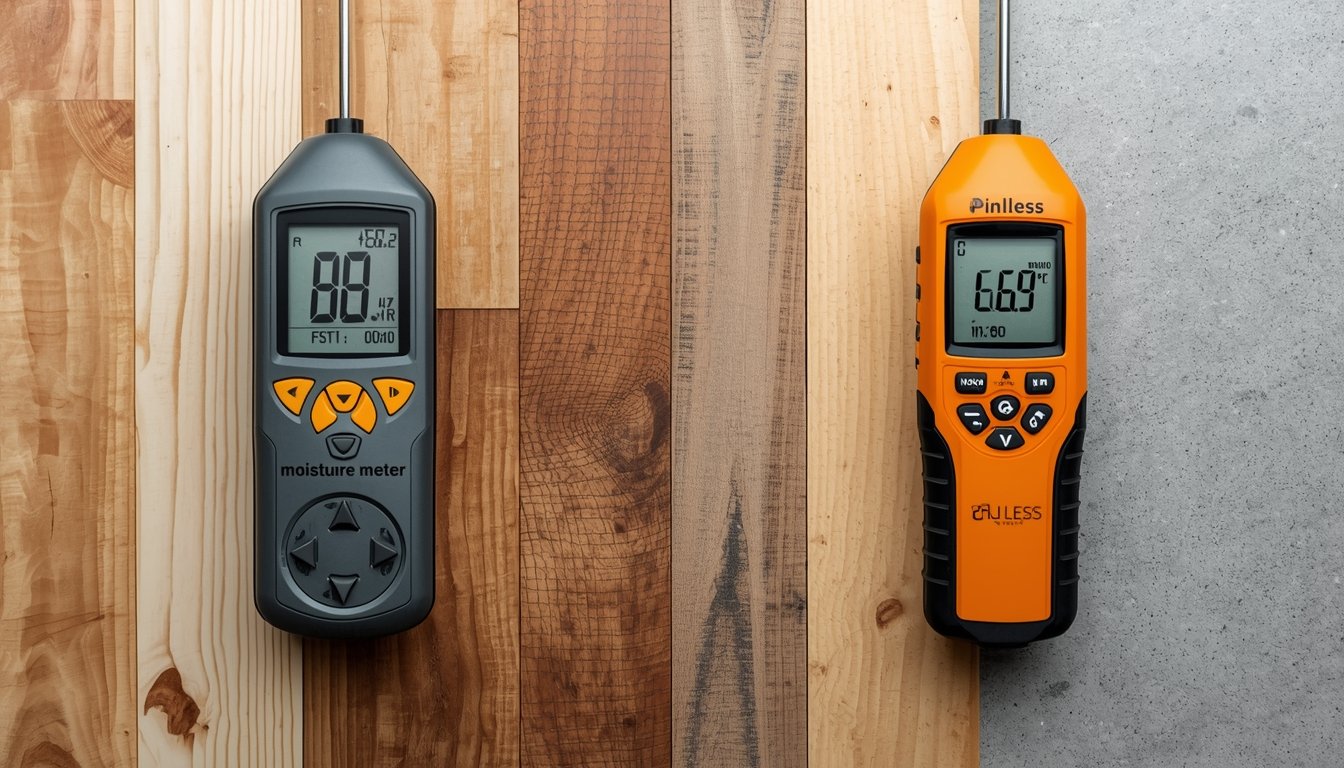
The most important features in a moisture meter are accuracy, material settings, ease of use, and the ability to compare readings across different areas. A good meter should help you quickly identify moisture problems without needing complex setup or interpretation.
Choosing the right features makes a big difference in how reliable and useful your readings will be.
Essential Features That Improve Accuracy and Usability
Some features have a direct impact on how well a moisture meter performs. These are the ones that matter most for everyday use in a home.
Focusing on these core features ensures you get consistent and meaningful readings rather than confusing or unreliable results.
- Material settings: Allows you to switch between wood, drywall, or masonry for more accurate readings
- Clear display: Easy-to-read screen with visible moisture levels or zones
- Consistent readings: Stable results when testing the same area multiple times
- Detection depth: Ability to measure beneath the surface rather than just the top layer
Material settings are especially important because different materials respond differently to moisture. Without the correct setting, readings can be misleading.
A clear display also helps you interpret results quickly, especially when comparing multiple areas during testing.
Features That Make Testing Faster and More Practical
Beyond accuracy, some features make a moisture meter easier and more efficient to use. These are particularly useful when scanning larger areas or doing regular checks.
These features don’t necessarily improve measurement accuracy, but they make the overall experience much smoother and more reliable.
- Pinless scanning: Allows fast testing without damaging surfaces
- Hold function: Locks the reading on screen for easier viewing
- Audible alerts: Beeps when moisture exceeds a certain level
- Backlit display: Makes it easier to use in low-light areas
For example, audible alerts can help you quickly identify problem areas without constantly watching the screen.
Pinless scanning is especially useful for finished surfaces like walls and floors, where you don’t want to leave marks.
If you’re unsure how these features affect readings, it helps to understand moisture meter readings and scales, so you can interpret results correctly.
How to Choose the Right Features for Your Needs
The best features depend on how you plan to use the moisture meter. Not everyone needs a high-end device with every option available.
For basic home use, a simple meter with the right core features is usually enough. For more detailed inspections, additional features can be helpful.
- For general home use: Focus on ease of use and basic accuracy
- For regular inspections: Look for consistent readings and material settings
- For more detailed checks: Consider additional features like deeper scanning
A common mistake is choosing a meter based on extra features that don’t improve real-world performance. In many cases, simplicity and reliability are more important than advanced options.
By focusing on the features that actually improve accuracy and usability, you can choose a moisture meter that fits your needs without overcomplicating the process.